
By Christine Lampert
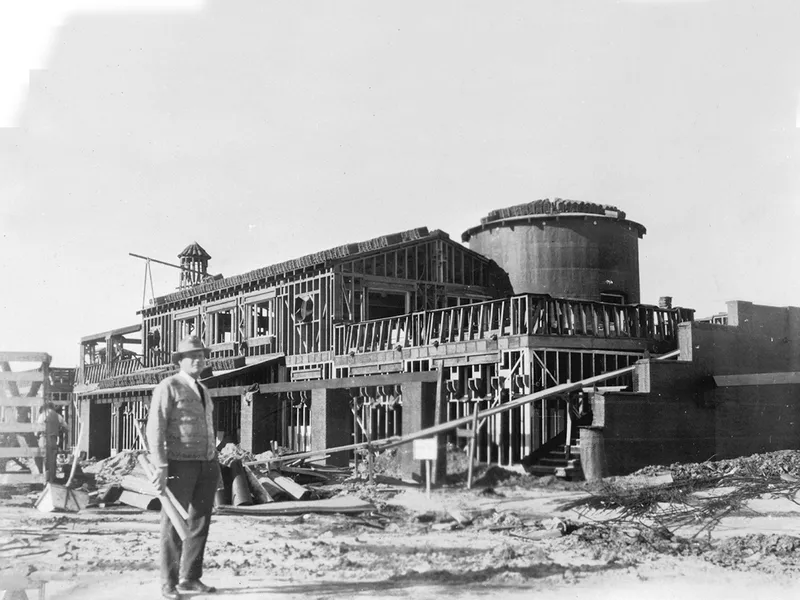
Virgil Westbrook, blueprints in hand, during construction of the community pool in 1928.
Imagine San Clemente in the 1920s as a small village where nearly every building reflected Spanish style architecture. At one time, the town had over 500 buildings constructed in the Spanish Colonial Revival style. Today, only about 200 of those original buildings remain. Ole Hanson, one of the founders of San Clemente, envisioned the town as a “Spanish Village by the Sea.” This vision flourished until the Great Depression of 1929 brought most construction to a halt.
The architect responsible for many of San Clemente’s most notable commercial and residential buildings was Virgil Westbrook. He arrived in San Clemente already well established, having designed numerous projects in Santa Barbara and Los Angeles. His Spanish Revival designs were both inspirational and magical, marked by elegant proportions and refined architectural details.
Beyond architecture, Virgil Westbrook was also a talented artist. He created detailed sketches of his buildings as well as wildlife drawings inspired by his time spent in the Sierra Nevada Mountains.
San Clemente founder Ole Hanson was a great admirer of Westbrook’s work. Westbrook even designed his own residence at 235 Avenida Miramar, a home that has been beautifully restored by its current owners. He lived there until 1945, when the house was sold. Today, it is owned by a young family who plan to continue enhancing the property in the coming years.
One of Westbrook’s most recognizable commercial designs is the Historic City Hall building located at the top of Avenida Del Mar at 101 S. El Camino Real. Though labeled “Old City Hall,” the building was only briefly used for city functions. Featuring strong Moroccan influences, it remains a striking architectural landmark and now serves as an office building with multiple tenants.
Directly across the street stands the Bartlett Building, another Westbrook design. Over the years, it has served many purposes and today functions as a successful retail space with additional tenants throughout the building.
Another notable Westbrook project is the Beach Club and swimming pool at North Beach. This well-proportioned structure has long served as the city’s Olympic-sized swimming pool and has hosted famous swimmers such as Esther Williams and Johnny Weissmuller, who were also well-known actors of their era.
St. Clement’s Church is another of Westbrook’s architectural contributions. Ole Hanson offered two empty lots across from Plaza Park to any church willing to build in the new town. The Episcopal Church accepted the offer and commissioned Westbrook to design the building, named after St. Clement. The church remains active and in use today.
One of Westbrook’s most prominent residential designs is located at 402 Pasadena Court, visible from Avenida Victoria as one drives past the pier and up the hill. Known as “Vista de las Olas,” meaning “View of the Waves,” the home offers clear ocean views from its living room.
Sisters Bertha and Emma Wierk hired Westbrook in 1926 to design the house, which was completed in 1927 on a site just above the beach. Although the gardens are now in disrepair, they once featured an impressive cascading tiled waterfall flowing down the hillside into a fountain.
Over the years, the property has been known by several names, including “The Wierk House,” “Sea Cliff,” and the “Robison Property.” A new owner is currently working with the city on plans to add to the property and transform it into a small hotel and restaurant.
Another Westbrook-designed home is located at 230 West Marquita. This modest one-bathroom house has been carefully restored over time, and the current owners hope to expand it slightly while making additional improvements.
Additional Westbrook residences include 199 Avenida La Cuesta on the hillside above town and 115 East Canada. In southwest San Clemente, a 1928 Westbrook home at 166 W. Avenida Alessandro stands as one of the few built that far south. The house has been beautifully restored and was recently sold to a new owner.
Sadly, not all of Westbrook’s most beautiful homes survived. The residence built for San Clemente’s first mayor, Thomas Murphine, on Avenida de los Alamos collapsed down the cliff just three days after the 1933 Long Beach earthquake, leaving only the carriage house behind.
Another lost masterpiece was the Bartow House, once located just south of the pier. The grand mansion was demolished in 1972 and replaced by a large condominium building. Its destruction sparked outrage among residents and led to the formation of the San Clemente Historical Society, which successfully lobbied the city to preserve historic properties.
There are many more Virgil Westbrook buildings throughout San Clemente, with over 30 documented in official city historic records.