
By Christine Lampert
Based on an article by Christine Lampert, Architect, AIA, NCARB
Ole Hanson was the visionary who master-planned San Clemente in the 1920s with his business partners. He developed a master-planned new town in the empty rolling hills halfway between Los Angeles and San Diego.
His plan was to provide the new “Spanish Village by the Sea” everything that was needed to thrive as a town. He built many of the important community structures that we use today and some that are gone.
Ole’s team not only laid out the future city with curved streets and neighborhoods, they planned and built everything that a new town would need, including the community center, the community pool, the pier, Max Berg Park, the first school, horse trails and stables, a hotel and a water system to provide drinking water and electricity. Most of the community buildings were gifted to the city for one dollar after they were completed.
Ole Hanson built the San Clemente Social Club. It was located where the existing Community Center is today at the corner of Avenida Del Mar and N. Calle Seville. The original two-story building was destroyed by a fire in 1970. The only original part of the rebuilt structure is the ‘Ole Hanson Room.’
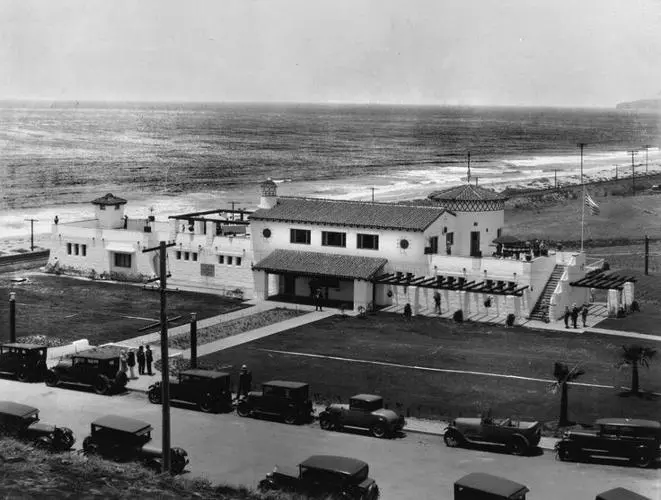
The swimming pool and Ole Hanson Beach Club in North Beach is the original building, even though it was remodeled a few years ago.
Every home was provided with electricity and water. The water reservoirs were built on the hill in the middle of town where the Presbyterian church is today. The very steep portion of Avenida Cabrillo that is between El Camino Real and de la Estrella, which led up to the water tanks, was a stairway for many years.
There were also horse stables for public use, in an area that is now the site of Ralphs grocery store. Several streets were designed with trails running down the middle to allow riders to access the beach with their horses. Avenida Esplanade is one street where there is a green belt down the center of the street, which was once a horse trail.
Ole also built the pier for use by the public. It was originally a fishing pier, and boats once anchored off the end of the pier to load and unload fishermen. The pier was built during The Prohibition Era (1920-1933). Because no alcohol could be legally sold in the U.S. during these years, the café at the end of the pier had a secret trap door for small boats to illegally deliver alcohol. The trap door was destroyed in the hurricane of 1939.
Later, in the 1940s, a boat club was formed and boat storage was built at the base of the pier, but in the 1970’s these buildings on the pier were converted to the spaces used for the Fisherman’s Restaurant today.
The hotel on Avenida Del Mar was originally built to house the construction workers and later was used for visitors in town.
Ole Hanson is responsible for a very innovative master-planned community. Historically, there are very few similar examples. His goal was to create a new town where families could live and play, and he succeeded.
Originally published: San Clemente Times
Christine Lampert is a member of the San Clemente Historical Society, as well as the American Institute of Architects (IA), and has designed many projects in San Clemente and California. She has been a professor of architecture at USC and SCAD Hong Kong. She and her family have lived in San Clemente for over 50 years.